

Will building costs continue rising?
Housing stats are expected to be at the bottom and remain flat.
“Residential construction costs rising at the slowest annual pace in over 20 years.” [1]
Most researchers and industry bodies are reporting rises of 4-6% PA or less depending upon the state/territory. 4-6% PA is manageable and not cause for alarm but it’s time to be cost aware as competition increases. It’s also time to price check your preferred subbies and suppliers to negotiate better prices.
What are the researchers saying?
CoreLogic Australia, July 2024
During FY24, annual costs increased 2.6%, marking the smallest annual rise in the national CCCl since March 2002 (2.3%) and significantly below the pre-COVID decade average of 4.0%.
HIA, State and National Outlooks, February 2024
Annual detached house commencements total of 96,250 detached house commencements in expected for 2023/24, down by 12.6 per cent on the previous year and down by almost a third on the 2020/21 peak. This will mark the trough of the cycle and the weakest financial year since 2012/13, over a decade earlier.
Commencements are expected to remain weak at 97,800 in 2024/25, just a 1.6 per cent improvement, before recovering and exceeding 110,000 by 2026/27.
HIA, Trades Report, December 2023 Quarter:
By trade, the most acute shortages existed in ceramic tiling (-1.04) and bricklaying (-1.03). This is the first time in over a decade where bricklayers were not experiencing the most acute shortages. This likely reflects the rapidly shrinking volume of new projects commencing construction and, therefore, falling demand for the trades required earlier in the construction process relative to ‘finishing’ trades. Other acute shortages persist in carpentry (-0.84), roofing (-0.81) and plastering (-0.79).
Trades prices have also moderated, increasing by just 0.4 per cent in the December Quarter 2023, to be up by 5.0 per cent for the calendar year. This compares to the almost 10 per cent increase seen in 2022, though is still much stronger than the 2.0 per cent average annual increase that prevailed before the pandemic. This reflects the ongoing demand for skilled tradespeople across the country.
Rawlinsons, Quarterly Update, July 2024:
Cost escalation in most states and territories has largely stabilised. We are seeing strong indications that the extreme material price increases experienced over the past few years have largely subsided.
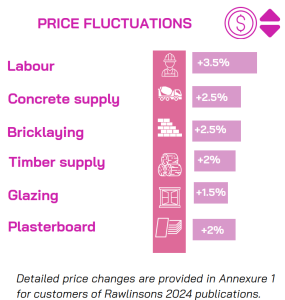
Contractor’s have the ability to estimate supply costs with more confidence and certainty and therefore reduce project risks…the biggest factor impacting cost increases at present is a skilled labour shortage, coupled with current industrial relation negotiations in most states.
Sydney price fluctuations example:
[1] CoreLogic Australia, 15 July 2024